

Which Of The Following Best Describes The Makeup Of The Human Genome?
Well-nigh the Human Genome Project
What was the Human Genome Project?
Begun formally in 1990, the U.S. Human Genome Project was a thirteen-year effort coordinated past the U.S. Department of Energy (DOE) and the National Institutes of Health (NIH; http://www.genome.gov/). The project originally was planned to last 15 years, but rapid technological advances accelerated the completion date to 2003. Projection goals
- identify all the approximately 20,000-25,000 genes in human being Deoxyribonucleic acid,
- determine the sequences of the 3 billion chemical base of operations pairs that make up human being Dna,
- store this information in databases,
- improve tools for data analysis,
- transfer related technologies to the private sector, and
- accost the ethical, legal, and social problems (ELSI) that may ascend from the project.
To help achieve these goals, researchers also studied the genetic makeup of several nonhuman organisms. These include the common human gut bacterium Escherichia coli, the fruit wing, and the laboratory mouse.
A unique aspect of the U.S. Human Genome Projection is that it was the first large scientific undertaking to address potential ELSI implications arising from project information. DOE and NIH Genome Programs ready bated 3% to five% of their respective almanac HGP budgets for the written report of these issues. About $i million was spent on HGP ELSI research.
Another important characteristic of the project was the federal government's long-standing dedication to the transfer of technology to the individual sector. By licensing technologies to private companies and awarding grants for innovative research, the projection catalyzed the multibillion-dollar U.S. biotechnology industry.
For more background data on the U.South. Human Genome Projection, see the following
- HGP Goals
- HGP Timeline
- Homo Genome News
How much did the Department of Energy and the National Institutes of Health spend on the Human Genome Projection?
| U.Due south. Homo Genome Projection Funding | |||
|---|---|---|---|
| ($Millions) | |||
| FY | DOE | NIH* | U.S. Total |
| 1988 | 10.7 | 17.ii | 27.9 |
| 1989 | 18.5 | 28.2 | 46.vii |
| 1990 | 27.two | 59.five | 86.seven |
| 1991 | 47.4 | 87.iv | 134.8 |
| 1992 | 59.4 | 104.8 | 164.2 |
| 1993 | 63.0 | 106.1 | 169.1 |
| 1994 | 63.three | 127.0 | 190.3 |
| 1995 | 68.7 | 153.8 | 222.5 |
| 1996 | 73.nine | 169.three | 243.two |
| 1997 | 77.nine | 188.9 | 266.eight |
| 1998 | 85.5 | 218.iii | 303.8 |
| 1999 | 89.9 | 225.seven | 315.half dozen |
| 2000 | 88.ix | 271.vii | 360.half dozen |
| 2001 | 86.4 | 308.4 | 394.8 |
| 2002 | 90.1 | 346.7 | 434.iii |
| 2003 | 64.2 | 372.8 | 437 |
Note: These numbers do non include construction funds, which are a very small part of the upkeep.
* For an caption of the NIH budget, contact the Office of Human Genome Communications, National Homo Genome Research Establish [https://world wide web.genome.gov/], National Institutes of Health.
What's a genome? And why is it important?
A genome is all the DNA in an organism, including its genes. Genes bear information for making all the proteins required by all organisms. These proteins determine, amidst other things, how the organism looks, how well its body metabolizes food or fights infection, and sometimes even how it behaves.
DNA is made upward of four similar chemicals (called bases and abbreviated A, T, C, and G) that are repeated millions or billions of times throughout a genome. The human genome, for example, has 3 billion pairs of bases.
The particular social club of As, Ts, Cs, and Gs is extremely important. The gild underlies all of life's diversity, even dictating whether an organism is human or some other species such as yeast, rice, or fruit fly, all of which take their ain genomes and are themselves the focus of genome projects. Because all organisms are related through similarities in DNA sequences, insights gained from nonhuman genomes often atomic number 82 to new knowledge most homo biological science.
How many genes are in the human genome?
The electric current consensus predicts well-nigh 20,500 genes, but this number has fluctuated a smashing deal since the projection began.
The reason for so much doubt has been that predictions are derived from dissimilar computational methods and gene-finding programs. Some programs discover genes by looking for distinct patterns that define where a gene begins and ends ("ab initio" gene finding). Other programs look for genes by comparison segments of sequence with those of known genes and proteins (comparative gene finding). While ab initio gene finding tends to overestimate cistron numbers by counting any segment that looks like a gene, comparative factor finding tends to underestimate since it is limited to recognizing merely those genes similar to what scientists take seen earlier. Defining a factor is problematic because small genes can exist difficult to discover, one gene can code for several poly peptide products, some genes lawmaking only for RNA, two genes can overlap, and many other complications (five).
Fifty-fifty with improved genome analysis, ciphering solitary is simply non plenty to generate an accurate cistron number. Conspicuously, gene predictions take to be verified past labor-intensive work in the laboratory (6).
Hither's a brief history of the changes in gene number over time.
2007: twenty,500
The 20,500 number of protein-coding genes was presented in a 2007 PNAS paper. Scientists arrived at this number past excluding the (now thought to be functionally meaningless, random occurrences) Open up-Reading Frames (ORFs) that were included in the 2003 estimate of 24,500 genes. [M. Clench et al., 2007. "Distinguishing Protein-Coding and Noncoding Genes in the Human Genome," PNAS 104(49), 19428-19433.]
2004: xx,000-25,000
October 2004 findings from The International Human Genome Sequencing Consortium, led in the United States past the National Human Genome Research Institute (NHGRI) and the Department of Energy (DOE), reduce the estimated number of human protein-coding genes from 35,000 to just twenty,000-25,000, a surprisingly low number for our species. At that time, Consortium researchers had confirmed the existence of 19,599 poly peptide-coding genes in the homo genome and identified another 2,188 Dna segments that are predicted to be poly peptide-coding genes. [International Human Genome Sequencing Consortium. 2004. "Finishing the Euchromatic Sequence of the Man Genome," Nature 431, 931-945.]
2003: 24,500 or fewer
In 2003, estimates from gene-prediction programs suggested there might be 24,500 or fewer protein-coding genes. The Ensembl genome-note system estimated them at 23,299. [Pennisi, East. 2003. "Gene Counters Struggle to Get the Right Reply," Science 301, 1040-1041.]
2003: Gene Sweep
Although the exact number of human genes was still uncertain, a winner of GeneSweep was announced in May 2003. GeneSweep was an breezy gene-count betting pool that began at the 2000 Cold Spring Harbor Laboratory Genome Meeting. Bets ranged from around 26,000 to more than 150,000 genes. Since most gene-prediction programs were estimating the number of protein-coding genes at fewer than 30,000, GeneSweep officials decided to declare the contestant with the lowest bet (25,947 by Lee Rowen of the Institute of Systems Biology in Seattle) the winner. [Pennisi, Due east. 2003. "A Low Number Wins the GeneSweep Pool," Science 300, 1484.]
2001: 42,000
This number was based on a written report past Dr. Michael P. Cooke, Dr. John B. Hogenesch, and colleagues at the Genomics Institute of the Novartis Research Foundation. They theorized in the written report that there was incomplete overlap between estimates of predicted genes made by Celera and by the Human Genome Sequencing Consortium. [J. Hogenesch et al, 2001. "A Comparison of the Celera and Ensembl Predicted Cistron Sets Reveals Fiddling Overlap in Novel Genes," Prison cell 106, 413–415.] and Followup Alphabetic character: [Mark J. Daly, 2002. "Estimating the Human being Gene Count," Prison cell 109, 283–284.]
2001: 65,000-75,000
An assay by scientists at Ohio State Academy suggested between 65,000 and 75,000 human genes. This number was arrived at "based on the integration of public transcript, protein, and mapping data, supplemented with computational prediction." [Wright, F., et al. 2001. "A Draft Annotation and Overview of the Human Genome," Genome Biology 2, 1-xviii.] and [Briggs, H. 2001. "Dispute Over Number of Human Genes," BBC News Online.]
2001: xxx,000-xl,000
When analysis of the typhoon homo genome sequence was published past the International Human Genome Sequencing Consortium on February fifteen, 2001, the paper estimated only virtually 30,000 to 40,000 poly peptide-coding genes, much lower than previous estimates of about 100,000. This lower judge came every bit a shock to many scientists considering counting genes was viewed as a way of quantifying genetic complexity. With about 30,000, the human gene count would be merely one-tertiary greater than that of the elementary roundworm C. elegans, which has nigh twenty,000 genes. [Claverie, J. 2001. "Gene Number. What if There are Only 30,000 Human being Genes?" Science 291, 1255–7.] and [Eastward.W. Lander et al., "Initial sequencing and analysis of the homo genome," Nature, 409, 860-921, 2001.] and [J.C. Venter et al., "The sequence of the human genome," Science, 291, 1304-51, 2001.]
2000: 120,000
Liang et al. 2000. "Gene index analysis of the homo genome estimates approximately 120,000 genes," Nat. Genet. 25, 239–240.
Whose genome was sequenced in the public (HGP) and private projects?
The man genome reference sequences do not represent whatsoever one person's genome. Rather, they serve equally a starting point for broad comparisons across humanity. The knowledge obtained from the sequences applies to everyone because all humans share the same bones set of genes and genomic regulatory regions that control the development and maintenance of their biological structures and processes.
In the international public-sector Human Genome Project (HGP), researchers collected claret (female person) or sperm (male) samples from a large number of donors. Only a few samples were candy equally DNA resource. Thus donors' identities were protected so neither they nor scientists could know whose Dna was sequenced. DNA clones from many libraries were used in the overall projection.
Technically, it is much easier to prepare DNA cleanly from sperm than from other cell types because of the much higher ratio of DNA to protein in sperm and the much smaller volume in which purifications tin can be done. Sperm contain all chromosomes necessary for study, including equal numbers of cells with the X (female) or Y (male) sex activity chromosomes. However, HGP scientists also used white cells from female donors' claret to include samples originating from women.
In the Celera Genomics individual-sector project, DNA from a few different genomes was mixed and processed for sequencing. Deoxyribonucleic acid for these studies came from bearding donors of European, African, American (North, Cardinal, Southward), and Asian ancestry. The lead scientist of Celera Genomics at that time, Craig Venter, has since acknowledged that his DNA was amid those sequenced.
Many polymorphisms—modest regions of Deoxyribonucleic acid that vary amid individuals—also were identified during the HGP, mostly unmarried nucleotide polymorphisms (SNPs). Most SNPs accept no physiological event, although a minority contribute to the beneficial diversity of humanity. A much smaller minority of polymorphisms affect an individual's susceptibility to disease and response to medical treatments.
Although the HGP has been completed, SNP studies keep in the International HapMap Project [http://hapmap.ncbi.nlm.nih.gov/], whose goal is to identify patterns of SNP groups (chosen haplotypes, or "haps"). The Dna samples for the HapMap Projection came from 270 individuals, including Yoruba people in Ibadan, Nigeria; Japanese in Tokyo; Han Chinese in Beijing; and the French Heart d'Etude du Polymorphisme Humain (CEPH) resources.
[Reply supplied by Dr. Marvin Stodolsky, formerly of the U.S. DOE Office of Science's Office of Biological and Environmental Research]
What U.Due south. laboratories and investigators were involved in the Human Genome Project?
Many laboratories around the Usa received funding from either the Department of Energy (DOE), the National Institutes of Health (NIH; http://www.genome.gov/), or both, for Homo Genome Project enquiry. The Human Genome Organization (HUGO; http://world wide web.hugo-international.org/) helped to coordinate international collaboration in the genome project. A listing of the major U.S. and international Human Genome Projection inquiry sites can exist found here.
Other individual researchers at numerous colleges, universities, and laboratories throughout the United States as well received DOE and NIH funding for human genome research. At whatever given time, the DOE Homo Genome Program funded most 200 separate principal investigators.
Why was the Department of Free energy involved in the Human Genome Project?
After the atomic bomb was developed and used, the U.S. Congress charged the Department of Free energy's (DOE) predecessor agencies (the Atomic Energy Commission and the Energy Research and Evolution Assistants) with studying and analyzing genome construction, replication, damage, and repair and the consequences of genetic mutations, especially those caused past radiation and chemic by-products of energy product. From these studies grew the recognition that the best mode to study these effects was to analyze the entire human being genome to obtain a reference sequence. Planning began in 1986 for DOE'due south Human being Genome Plan and in 1987 for the National Institutes of Health's (NIH) programme. The DOE-NIH U.Due south. Homo Genome Project formally began Oct 1, 1990, later the first articulation 5-year plan was written and a memorandum of agreement was signed between the ii organizations. For more information see Progress of the Human Genome Project and DOE Biological and Ecology Research Program.
Consistent with the goals of the Human Genome Project, the DOE Human Genome Programme focused on the following:
- Mapping (more data) human being chromosomes 2, five, 11, Ten, 16, xix, and 21;
- Comparative studies between mouse and human genomes
- Development of important biological resource for the Human Genome Project and the broader biomedical research communities, including purified Deoxyribonucleic acid collections for each human chromosome and sequence-fix DNA
- Technologies, instrumentation, and robotics for more than efficient DNA sequencing;
- Development of analysis algorithms and integration of databases (computer science) for managing and interpreting genome data
- Communicating virtually the Homo Genome Project to those who would interpret it for various professions and ultimately for the public
Another important DOE goal was to foster research into the ethical, legal, and social implications (ELSI) of genome research. The DOE Human being Genome Program ELSI component and the information information technology generated concentrated on two master areas: (1) privacy and confidentiality of personal genetic information, including its accumulation in large, computerized databases and databanks; and (2) development of educational materials and activities in genome scientific discipline and ELSI, including curricula and Television documentaries, workshops, and seminars for targeted audiences. Other areas of interest include information privacy arising from potential uses of genetic testing in the workplace and bug related to commercialization of genome research results and technology transfer.
For more than details on the Department of Energy's involvement, see the post-obit:
- "Evolution of a Vision -- Function I" by David Smith
- "Evolution of a Vision -- Office II" by Francis S. Collins
- "The Alta Summit, December 1984" by Robert Mullan Cook-Deegan
What DOE investments improved the efficiency of the Human Genome Project by reducing costs, speeding progress, furthering engineering?
Making the Project Possible
Its long-continuing mission to sympathise and characterize the potential wellness risks posed by energy use and product led DOE to propose, in the mid-1980s, that all three billion bases of DNA from an "average" human should be sequenced. Technologies available before that time had not enabled the routine detection of extremely rare and ofttimes minute genetic changes resulting from radiation and chemic exposures.
The scientific foundation for DOE's Man Genome Initiative already existed at the national laboratories.
- DOE had a long history of conducting large multidisciplinary projects involving biologists, chemists, engineers, and mathematicians.
- Genbank, a Deoxyribonucleic acid sequence repository, had been developed at Los Alamos National Laboratory (LANL) with DOE figurer and data-management expertise. Today, Genbank, the globe's principal DNA sequence database, resides at the National Library of Medicine.
- Chromosome-sorting capabilities essential to a genome initiative existed at LANL and Lawrence Livermore National Laboratory (LLNL). Using this engineering science, LANL and LLNL began the National Laboratory Factor Library Project, a drove of cloned DNAs from single human chromosomes.
In 1986, DOE became the first federal agency to denote and fund a genome plan.
Developing the Tools and Technologies for Success
[NOTE: The DOE investments described below helped brand the Human being Genome Project a success. Substantial investments by NIH and the Wellcome Trust in the U.K. were equally important, however, and should non be overlooked. In most cases, the DOE successes outlined below were the outcome of basic research programs. Research is an incremental process that learns from both the successes and failures of other research investments, including those at other agencies and organizations. In addition, no single musical instrument, applied science, reagent, or protocol fabricated high-throughput Deoxyribonucleic acid sequencing possible, many contributors were responsible.]
Dna Sequencers
Research on capillary-based Deoxyribonucleic acid sequencing contributed to the development of the two major DNA sequencing machines—the Perkin-Elmer 3700 and the MegaBace DNA sequencers. The MegaBace Dna sequencer was developed initially with DOE funds past Dr. Richard Mathies at U.C. Berkeley. The Perkin-Elmer 3700 was based, in part, on DOE-funded research by Dr. Norman Dovichi at the Academy of Alberta. These high-throughput instruments are one of the keys to the success of the genome projection.
Fluorescent dyes
DNA sequencing originally used radiolabeled DNA subunits. DOE-funded research contributed to the evolution of fluorescent dyes that increased the accuracy and safe of DNA sequencing equally well every bit the power to automate the procedures.
Deoxyribonucleic acid cloning vectors
Before large DNA molecules can be sequenced, they are cutting into pocket-size pieces and multiplied, or cloned, into numerous copies using microbial-based "cloning" vectors. Today, the bacterial artificial chromosome (BAC) is the well-nigh commonly used vector for initial DNA amplification earlier sequencing. These cloning vectors were developed with DOE funds.
BAC-end sequencing
The widely agreed-upon strategy for sequencing the homo genome is based on the use of BACs that carry fragments of human Deoxyribonucleic acid from known locations in the genome. DOE-funded enquiry at The Found for Genomic Inquiry in Rockville, Maryland, and at the University of Washington provided the sequencing community with a complete set of over 450,000 BAC-based genetic "markers" corresponding to a sequence tag every iii to 4 kilobases across the entire human genome. These markers were needed to assemble both the draft and the last human Deoxyribonucleic acid sequence.
GRAIL
GRAIL (Factor Recognition and Assembly Cyberspace Link) is one of the well-nigh widely used computer programs for identifying potential genes in DNA sequence and for general DNA sequence analysis. This powerful analytical tool was adult with DOE funds by Dr. Ed Uberbacher at Oak Ridge National Laboratory. Although a number of gene-finding tools are now available for utilise, GRAIL led the fashion.
Reducing Costs and Speeding Upwardly Sequencing
The higher up technological developments dramatically decreased Deoxyribonucleic acid sequencing'due south cost while increasing its speed and efficiency. For example, it took iv years for the international Human Genome Project to produce the first billion base pairs of sequence and less than 4 months to produce the second billion base pairs. In the month of Jan 2003, the DOE squad sequenced 1.5 billion bases. The cost of sequencing has dropped dramatically since the project began and is however dropping quickly.
Human Genome Projection 1990–2003
The Human Genome Projection (HGP) was an international 13-year effort, 1990 to 2003. Primary goals were to detect the complete prepare of human genes and make them accessible for further biological study, and determine the complete sequence of Deoxyribonucleic acid bases in the human genome. See Timeline for more HGP history.
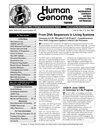
Homo Genome News
Published from 1989 until 2002, this newsletter facilitated HGP communication, helped prevent duplication of research endeavour, and informed persons interested in genome research.

Which Of The Following Best Describes The Makeup Of The Human Genome?,
Source: https://web.ornl.gov/sci/techresources/Human_Genome/project/index.shtml
Posted by: brownpublienew46.blogspot.com
0 Response to "Which Of The Following Best Describes The Makeup Of The Human Genome?"
Post a Comment